The Architect and the Improviser: Inside the Two Minds of AI
Every developer knows the feeling: the powerful urge to skip the planning and just start coding. It’s a very human trait, driven by a desire to get something done. The novice programmer, eager to make progress, dives headfirst into the code. They build something that works—a tangible prototype. Before long, complexity increases as they get closer to the underlying application, teasing out quality of life improvements or edge cases features that creep in. Without a plan, they can quickly find themselves on a gerbil wheel of counter-productive, conflicting activities.
This kind of exploratory coding is a perfectly valid way to learn, but it requires the maturity to know when to throw the prototype away and start again producing a better design with your new knowledge. Real trouble might begin if that exploratory work is presented as a finished solution, and a business, seeing a working prototype, decides it's good enough to move forward. This complex situation requires maturity from all parties. It also perfectly mirrors the fundamental conflict playing out inside our most advanced AIs, which also grapple with the tension between structured planning and reactive agility. Understanding this split is the key to understanding how they work and what they'll build next.
The Human Blueprints: Two Ways to Build Anything
Before you can build an AI brain, you have to understand the blueprints. For decades, humans have used two radically different strategies to manage complex projects. These aren't just management styles; they're philosophies about how to wrangle chaos into creation.
Meet the Architect: The Waterfall Mindset 🏛️
Imagine building a skyscraper. You wouldn't just start laying bricks and see what happens. You'd demand a complete, exhaustive blueprint first. Every floor, every wire, every window is planned, documented, and signed off on before a single piece of steel is erected. This is the Waterfall model.
It's a rigid, linear, and sequential doctrine where you complete one entire phase before moving to the next:
- Requirements: Get every single detail from the client. The plan is locked.
- Design: Draft the master blueprint based on those requirements.
- Implementation: Build the thing, following the blueprint exactly.
- Verification: Test the final product to see if it matches the original plan.
- Maintenance: Deploy and support the finished product.
The strength of this approach is its predictability. Budgets and timelines are clear. Its weakness? It's utterly inflexible. If you realize on floor 30 that the lobby design is wrong, the cost to change it is astronomical. Waterfall works beautifully for things with stable, known requirements, like construction or manufacturing.

Enter the Rebel: The Agile Approach 🌪️
Now, imagine building a revolutionary new app. You don't know exactly what users will want. The market changes weekly. A rigid, upfront plan is a death sentence. You need a different approach: Agile.
Agile isn't a single process; it's a mindset that values flexibility and collaboration above all. It's built on four core values:
- Individuals and interactions over processes and tools.
- Working software over comprehensive documentation.
- Customer collaboration over contract negotiation.
- Responding to change over following a plan.

Instead of one giant delivery at the end, Agile works in short, iterative cycles called "sprints." You build a small, functional piece of the product, show it to the customer, get their feedback, and adapt your plan for the next sprint. It's a continuous loop of building, learning, and adjusting. This makes it perfect for fast-moving fields like software development where requirements are guaranteed to evolve.

So, which is better? That's the wrong question. They are two different tools for two different jobs. This isn't just a choice for human teams; it's a fundamental conflict that can lead to 'paralysis by analysis' if over-planning stifles action. This same tension between meticulous planning and iterative adaptation is now playing out inside the minds of our most advanced AIs.
The Ghost in the Machine: Two AI Brains Are Born
As Large Language Models (LLMs) grew powerful enough to not just talk, but to act—to use tools, call functions, and execute workflows—they needed a "cognitive architecture" to guide their behavior. Two dominant patterns emerged, and they look uncannily like our human project management styles.
The Planner-Executor: AI's Master Strategist 🧠
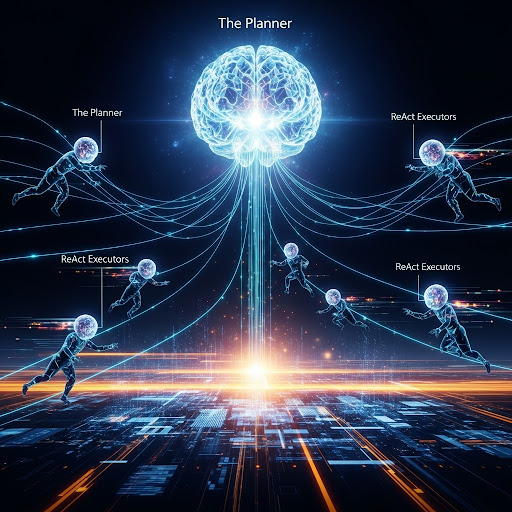
The Planner-Executor architecture is the AI equivalent of the Waterfall model. It's designed to tackle complex tasks by separating high-level strategy from low-level action. This structure is remarkably similar to the hierarchy of a business, where the C-suite makes strategic decisions and provides a budget for their employees to execute implementation tasks.
This mirrors a fundamental economic principle. Fungible currency, like a budget, is an abstract measure of value. Its true potential is only unlocked when it's put to work. Real, tangible value is created only when that abstract currency is exchanged to produce a product or service. In the same way, the Planner's "budget" of instructions is just potential until the Executor transforms it into a tangible result.
It works in two distinct phases:
- The Planner (The C-Suite): You give the agent a complex goal, like "Research the market for electric vertical-takeoff-and-landing aircraft and produce a detailed report." The Planner, a powerful LLM, acts like the C-suite, thinking through the entire task from start to finish and generating a complete, step-by-step blueprint. It might look like:
- Step 1: Search for top eVTOL manufacturing companies.
- Step 2: For each company, find their latest funding rounds and key investors.
- Step 3: Research current regulatory hurdles from the FAA and EASA.
- Step 4: Synthesize all findings into a structured report.
- The Executor (The Employees): This component (which can be a simpler AI or even a non-LLM function) takes the plan and, like an employee given a set of tasks, blindly executes each step one by one. Its only job is to follow the blueprint.
The advantage is speed and efficiency. The big, expensive Planner LLM is only called once at the start. This makes it much faster and cheaper for long, complex tasks. Its great weakness, just like Waterfall, is its brittleness. If the initial plan is flawed (e.g., it forgot to first identify what "eVTOL" means), the Executor will fail, often without knowing why until the very end. This highlights how risk in this model can be mitigated by ensuring the initial plan is sound. In the future, building competent AI agents with validated expertise for these roles could remove human error from the complex orchestration of an organization.

The ReAct Agent: AI's Improvisational Genius ⚡
The ReAct (Reason + Act) architecture is the spirit of Agile brought to life in an AI. It doesn't create a grand plan. Instead, it operates in a tight, continuous, iterative loop, thinking and acting in small increments.
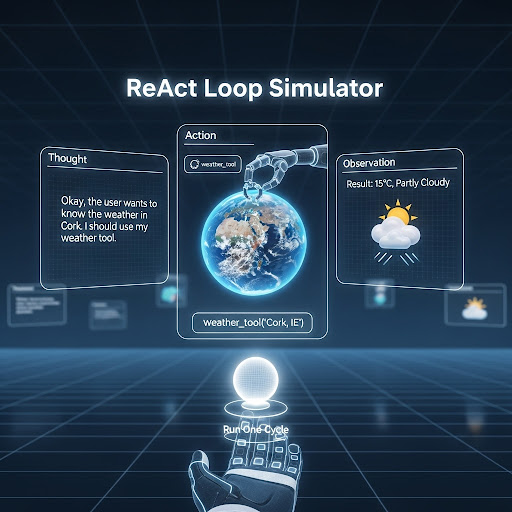
Each cycle of the Thought-Action-Observation loop is a micro-sprint:
- Thought: The agent thinks to itself, forming an "inner monologue" to assess the situation and decide on the very next step. E.g., "I need to find out what a 'FLoRA' device is. I should start by searching for it."
- Action: Based on the thought, it generates a single, executable action, like search("FLoRA device").
- Observation: It executes the action and gets feedback from the environment (e.g., a snippet from a search result). This observation is then fed into the next loop, starting a new Thought.

ReAct's power is its adaptability. It can "act to reason," using the world to inform its thinking. It's highly interpretable because you can read its chain of thought. Its weakness? It can be "painfully slow" and expensive, as it has to stop and call the main LLM after every single action. It's like a car restarting its engine at every single traffic light.
Feature | Planner-Executor | ReAct |
Core Loop | Decoupled Plan -> Execute | Interleaved Thought->Action->Obs |
Planning Style | Upfront & holistic | Iterative & myopic |
Execution Flow | Linear execution of plan | Stops to think after each action |
LLM Call Frequency | Low | High |
Adaptability | Less adaptive | Highly adaptive |
Key Weakness | Brittle if plan is flawed | Slow and potentially sub-optimal |
The Grand Synthesis: Why AI Brains Mirror Human Teams
This isn't just a fun comparison. The parallels are so deep they reveal a shared logic for solving problems.
- Planner-Executor is Waterfall: Both rely on heavy, upfront planning to create a rigid, sequential roadmap. Their success depends entirely on the quality of that initial plan. The risk is concentrated at the beginning; a bad plan dooms the entire project.
- ReAct is Agile: Both operate in short, iterative, feedback-driven cycles. They excel in dynamic environments where the path isn't clear. The solution emerges from the process, rather than being defined at the start.
This shared logic leads to an inescapable conclusion. In both project management and AI, practitioners realized that the purest forms of each philosophy were too extreme. The real world demands both strategic foresight and tactical flexibility.
Building the Brains: Your Toolkit for Creating AI Agents
Loading AI Creation Video...
Crafting AI agents with LangGraph, AutoGen, and LlamaIndex in a futuristic forge setting.
These architectures aren't just theory; you can build them today using powerful open-source frameworks. The choice of framework depends on whether you want to be a state machine designer, a team manager, or a specialist.
- LangChain / LangGraph: This is the low-level, high-control option. Using LangGraph is like designing a state machine, explicitly defining every node (the planner, the executor) and every edge (the control flow). It gives you maximum power but has a steeper learning curve.
- AutoGen: Backed by Microsoft, this framework is intuitive. You think like a manager. You create agents with roles ("You are a master planner," "You are a code executor") and put them in a "GroupChat" to collaborate. It's fast for prototyping complex, team-based workflows.
- LlamaIndex: This framework shines when your agent needs to work with large amounts of custom data (a technique called RAG). It provides robust, pre-built agent classes like ReActAgent that work out-of-the-box, accelerating development for data-centric tasks.
Feature | LangChain / LangGraph | AutoGen | LlamaIndex |
Primary Abstraction | Graph / Chain - LangChain uses linear "Chains." LangGraph adds "Graphs" (nodes/edges) for cyclical, stateful agentic workflows. | Multi-Agent Conversation - Agents with different roles and capabilities collaborate by exchanging messages to solve problems. | Data Pipeline / RAG - Core focus is on indexing data and making it available to an LLM through query engines and retrievers. |
Primary Abstraction | Native & Customizable - Full control to build ReAct loops from scratch using graph nodes and state. | Supported via Prompting - ReAct logic is implemented by crafting specific system prompts that guide an agent through the thought-action-observation cycle. | High-Level API - Provides a pre-built ReActChatEngine that applies the ReAct reasoning loop over a data index. |
Planner-Executor Implementation | Native & Customizable - Explicit patterns for a "planner" agent to create/update a task list and an "executor" agent to run tasks. | Achievable via Agent Roles - One agent acts as a "planner/manager" that delegates tasks to other "executor/worker" agents within the conversation. | Emerging via Workflows - Less explicit than LangGraph, but its "Workflows" feature enables multi-step processes that function like a plan-and-execute model over data sources. |
Control vs. Simplicity | High Control ⚙️ - LangGraph provides granular control over agent state, logic, and flow, at the cost of increased complexity. | Balanced ⚖️ - High control over the multi-agent architecture, but the conversational paradigm simplifies the orchestration logic. | High Simplicity ✨ - Excels at simplifying RAG and agent creation over data with high-level APIs. Offers less granular control over the agent's internal logic. |
The Future is Hybrid: The Dawn of AI Teamwork
The most advanced agentic systems today are no longer pure Planner-Executors or pure ReAct agents. They are hybrids. This is the most important trend in AI development.
The most powerful pattern emerging is a Planner-Executor with a ReAct-based Executor.
- A high-level Planner agent creates the strategic, multi-step plan (the Waterfall part).
- Each step is then handed off to an Executor who is, itself, a full ReAct agent (the Agile part).
This gives you the best of both worlds: the long-term coherence of a master plan combined with the adaptive, resilient problem-solving of a reactive agent. Think of it like a master architect providing the grand blueprint for a skyscraper, while trusting skilled construction crews on-site to solve the immediate, practical challenges of building each floor. This hierarchical, layered approach is the roadmap for building the next generation of truly intelligent machines.